
Last updated: September 2026. This guide covers Canadian mortgages. It is educational content, not financial advice.
Choosing between a fixed and a variable rate is one of the biggest decisions Canadian homebuyers and renewing homeowners face. In 2026, the choice is especially interesting: variable rates are starting close to a full percentage point below the best fixed rates, but inflation risks and rising bond yields make the future uncertain.
In this guide we explain how fixed and variable mortgages work in Canada, compare their costs with real numbers, cover penalties and trigger rates, and help you decide which option fits your finances and comfort with risk. We also look at hybrid mortgages, the option to lock in a variable rate later and how your choice affects the mortgage stress test, so you can make a decision with the full picture in front of you.
The Short Answer
- Choose a fixed rate if you want predictable payments, have a tight budget, or would lose sleep if your payments rose.
- Choose a variable rate if you can handle payment changes, want lower penalties if you break your mortgage, and are comfortable with the risk that rates could rise.
Neither option is always better. The best choice depends on your finances, your plans and how you feel about risk.
How Fixed Rate Mortgages Work in Canada
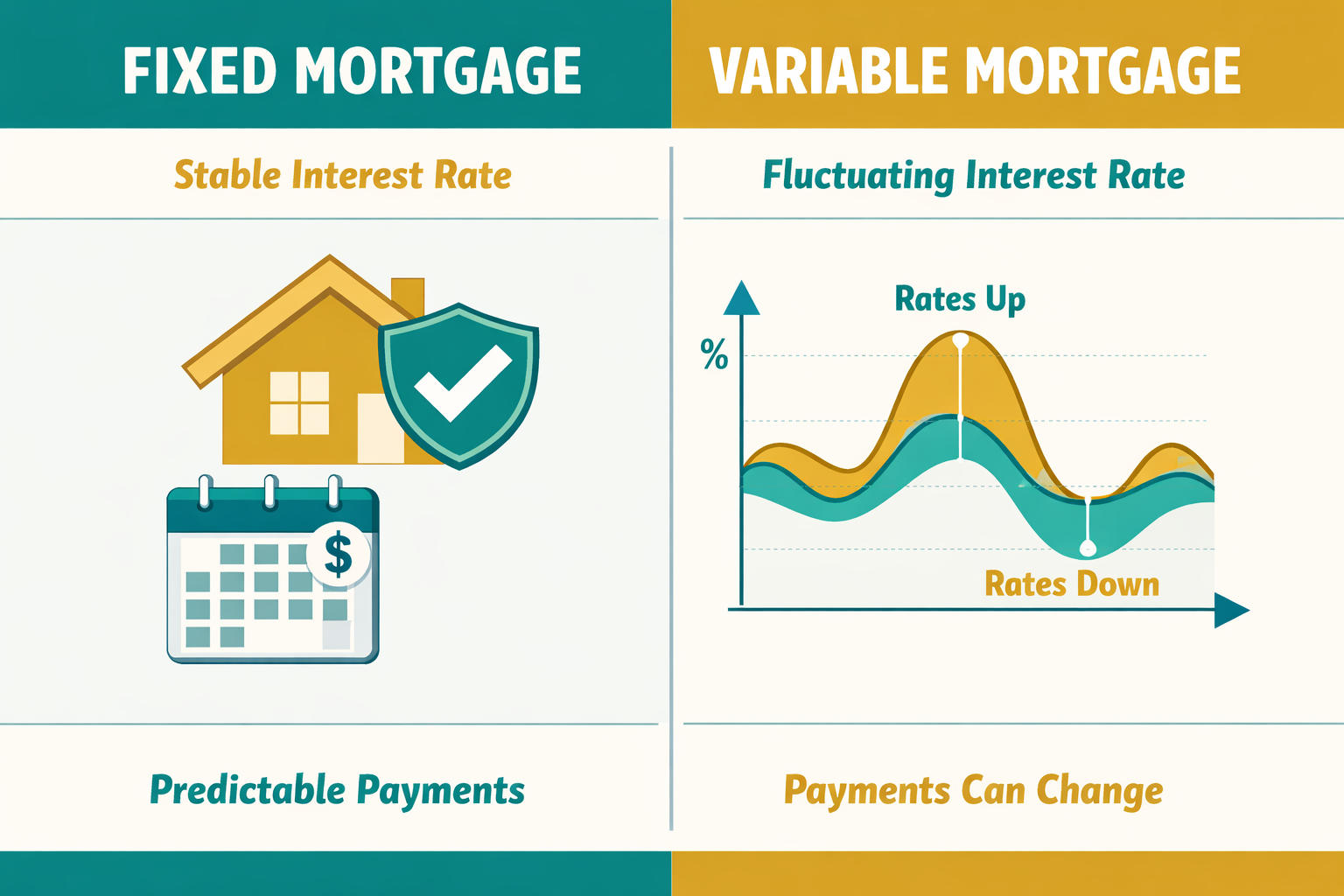
With a fixed rate mortgage, your interest rate is locked for the length of your term, which in Canada is usually one to five years, sometimes up to ten. Your payment stays the same throughout the term, no matter what happens to the Bank of Canada rate.
When the term ends, you renew at whatever rates are available at the time. That means a fixed rate protects you for the term, not for the whole life of your mortgage.
Fixed rates in Canada are mainly influenced by Government of Canada bond yields, especially the five year bond. When bond yields rise, fixed mortgage rates usually follow.
How Variable Rate Mortgages Work in Canada
A variable rate is set as the lender’s prime rate plus or minus a discount. Prime moves with the Bank of Canada’s policy rate, so when the Bank raises or lowers rates, your mortgage rate changes too.
For example, with prime at 4.45%, a variable rate of prime minus 1.20% equals 3.25%. If the Bank of Canada raised its rate by 0.25 percentage points, your rate would rise to 3.50%.
There are two main types of variable mortgage in Canada:
| Type | How payments work | What happens when rates rise |
|---|---|---|
| Adjustable rate mortgage (ARM) | Your payment changes whenever prime changes | Your payment goes up right away |
| Variable rate mortgage (VRM) with fixed payments | Your payment stays the same, but the split between interest and principal changes | More of each payment goes to interest, and you may hit your trigger rate |
What is a trigger rate?
With a fixed payment variable mortgage, there is a point where your payment only covers the interest. This is called the trigger rate. If rates rise beyond it, your payment may not cover all the interest, and your balance can grow. Many Canadian borrowers reached their trigger rates during the rapid rate increases of 2022 and 2023, which led lenders to raise payments or extend amortizations.
Current Rates: Fixed vs Variable in 2026
As of late September 2026:
| Rate | Figure |
|---|---|
| Bank of Canada policy rate | 2.25% (held on September 2, 2026) |
| Prime rate | 4.45% |
| Best advertised 5 year variable | around 3.25% to 3.30% |
| Best advertised 5 year fixed | around 4.09% to 4.24% |
Sources: Bank of Canada, Ratehub.ca and WOWA.ca, September 23, 2026.
The gap between the best variable and fixed rates is about 0.9 percentage points. That is a large head start for variable borrowers. However, the Bank of Canada noted in September that headline inflation was hovering around 3% because of higher gasoline prices, and it flagged upside risks. Its next decision is on October 28, 2026.
Running the Numbers: A Five Year Comparison
Let’s compare a $500,000 mortgage with a 25 year amortization over a five year term:
- Fixed: 4.14% for five years, with a payment of about $2,668 a month.
- Variable: starting at 3.25%, with a payment of about $2,437 a month.
The fixed borrower pays about $96,400 in interest over five years. What the variable borrower pays depends on what happens to rates. In these examples, the variable rate changes after one year and then stays at the new level:
| Variable rate scenario | Payment after the change | Interest paid over 5 years | Compared with fixed |
|---|---|---|---|
| Rates fall 0.50 points | $2,311 | about $66,400 | about $30,000 less |
| Rates stay the same | $2,437 | about $75,800 | about $20,600 less |
| Rates rise 0.50 points | $2,566 | about $85,200 | about $11,200 less |
| Rates rise 1.00 point | $2,699 | about $94,700 | about $1,700 less |
| Rates rise 1.50 points | $2,836 | about $104,200 | about $7,800 more |
Illustrative figures only, assuming an adjustable payment. Actual results depend on the timing and size of rate changes, your lender and your mortgage terms.
What this example shows
- Variable wins unless rates rise significantly. In this example, rates would need to rise by more than about one percentage point, fairly soon, before the fixed rate came out ahead.
- The risk is real. In the worst scenario, the variable payment rises by about $400 a month. That can be hard to absorb on a tight budget.
- The gap matters. The bigger the difference between fixed and variable rates, the more room the variable borrower has before losing out.
What History Says
A frequently cited study by York University professor Moshe Milevsky found that Canadian borrowers who chose variable rates would have paid less interest than those who chose fixed rates in most periods between 1950 and 2000. More recent periods have been mixed. Borrowers who took variable rates in 2021, for example, faced sharp increases when the Bank of Canada raised its rate to 5.00% in 2023.
The lesson is that variable rates have often been cheaper over the long run, but not always, and the short term pain can be severe when rates rise quickly.
Penalties: A Big Difference Between Fixed and Variable
Breaking a mortgage before the end of your term is more common than many people expect, whether because of a move, a separation or a refinance. The penalty rules are very different:
| Mortgage type | Typical penalty for breaking early |
|---|---|
| Variable | Three months of interest |
| Fixed | The greater of three months of interest or the interest rate differential (IRD) |
IRD penalties at some big banks can reach thousands, or even tens of thousands, of dollars, because they are calculated using posted rates. Variable mortgages usually offer much more predictable and lower penalties. If there is any chance you will break your mortgage early, this can be a major point in favour of variable.
Can You Switch From Variable to Fixed?
Most lenders let you convert a variable mortgage to a fixed rate at any time without a penalty, usually into a term of the same length or longer. However, you will get the lender’s fixed rate at the time you switch, which may be higher than rates available elsewhere. Switching from fixed to variable usually means breaking the mortgage and paying a penalty.
Hybrid Mortgages
Some Canadian lenders offer hybrid or combination mortgages, where part of your loan is fixed and part is variable. This spreads your risk: if rates rise, only part of your mortgage is affected; if they fall, you still benefit on the variable portion. Hybrid mortgages can be harder to switch between lenders at renewal, so check the terms carefully.
How the Stress Test Affects Your Choice
To qualify for a mortgage from a federally regulated lender, you must pass the mortgage stress test, which checks whether you could afford your payments at the higher of your contract rate plus 2% or 5.25%. With today’s rates, a 3.25% variable mortgage is tested at 5.25%, and a 4.14% fixed mortgage is tested at 6.14%. That means choosing variable can slightly increase the amount you qualify for. Learn more in our guide to the mortgage stress test in Canada.
Pros and Cons
Fixed rate
Pros: predictable payments; protection from rate increases during the term; easier budgeting.
Cons: currently higher starting rate; potentially large IRD penalties; you do not benefit if rates fall.
Variable rate
Pros: lower starting rate in 2026; lower penalties; benefits immediately from rate cuts; can usually convert to fixed.
Cons: payments or amortization can increase; risk of reaching the trigger rate; harder to budget.
Which Is Right for You? Questions to Ask
Could you handle a higher payment?
Work out your payment if rates rose by 1 or 2 percentage points. If that would put serious pressure on your budget, a fixed rate is likely safer.
Might you break your mortgage early?
If you might move, sell or refinance within the term, the lower penalty on a variable mortgage could save you a lot.
Do you have savings to fall back on?
An emergency fund makes it easier to ride out payment increases on a variable mortgage.
How will you feel if rates rise?
Some people are comfortable with ups and downs; others prefer certainty. Be honest with yourself.
What term length suits you?
In 2026, some borrowers are choosing a three year fixed as a middle ground: more certainty than a variable rate, but a shorter commitment than a five year fixed.
Who Each Option Suits
A fixed rate often suits:
- First time buyers stretching to afford their home.
- Households on a single income or with little savings.
- Borrowers who plan to stay in their home for the whole term.
- Anyone who values a predictable budget above potential savings.
A variable rate often suits:
- Borrowers with savings or spare monthly income to absorb increases.
- People who may sell, move or refinance before the term ends.
- Those who want to benefit from any future rate cuts.
- Borrowers who plan to make large prepayments and want flexibility.
Common Mistakes to Avoid
- Choosing only on the starting rate. Think about what happens if rates rise.
- Ignoring penalties. An IRD penalty can wipe out years of savings.
- Forgetting the trigger rate on a fixed payment variable mortgage.
- Not reading the conversion rules before choosing variable.
- Accepting your renewal offer without comparing. Rates vary widely between lenders.
Frequently Asked Questions
Is a variable rate mortgage a good idea in 2026?
It can be. Variable rates currently start about 0.9 percentage points below the best fixed rates. However, inflation risks mean rates could rise, so a variable rate suits borrowers who can handle higher payments.
What is the difference between an ARM and a VRM?
With an adjustable rate mortgage, your payment changes when prime changes. With a variable rate mortgage with fixed payments, your payment stays the same, but more or less of it goes to interest.
How much is the penalty for breaking a variable mortgage?
Usually three months of interest. For a fixed mortgage, it is usually the greater of three months of interest or the interest rate differential.
Can I lock in my variable rate later?
Most lenders allow you to convert to a fixed rate at any time without a penalty, but you will receive the lender’s current fixed rate.
Should I choose a shorter fixed term?
A shorter term, such as two or three years, can make sense if you expect rates to fall or plan to move. You will renew sooner, which brings both opportunity and risk.
Does my payment frequency matter?
Yes. Choosing accelerated biweekly or weekly payments, instead of monthly, means you make the equivalent of one extra monthly payment each year. This shortens your amortization and reduces interest on both fixed and variable mortgages.
Are fixed rates going up in Canada?
Fixed rates follow bond yields, which have been rising in 2026. No one can predict their direction with certainty.
The Bottom Line
In Canada, a fixed rate mortgage gives you predictable payments for your term, while a variable rate offers a lower starting rate, lower penalties and the chance to benefit from rate cuts, with the risk of higher costs if rates rise. In our example, the variable option would stay cheaper unless rates rose by more than about one percentage point early in the term.
If you value certainty or have a tight budget, fixed may be the better fit. If you have room in your budget and might need flexibility, variable could save you money. Whatever you choose, read the penalty and conversion rules carefully, compare offers from several lenders and speak with a licensed mortgage professional before deciding.
Disclaimer: This article is for general educational purposes only and does not constitute financial advice. Rates are based on Bank of Canada and public rate comparison data for September 2026 and are not offers of credit. Examples are illustrative. Always confirm rates, penalties and terms with your lender or a licensed mortgage professional.