
Last updated: September 2026. This guide explains the capitalisation rate for rental and investment property. It is general information only, not financial or investment advice.
If you have looked at any investment property listing or real estate report, you have probably seen the term cap rate. It is one of the most widely used numbers in property investing, and one of the most misunderstood. A cap rate can help you compare properties quickly, but on its own it does not tell you whether a deal is good.
In this guide we explain what the cap rate is, how to calculate it step by step, what counts as a good cap rate in 2026, how it differs from other return measures and the mistakes investors make when using it.
What Is a Cap Rate?
The capitalisation rate, or cap rate, measures the annual income a property produces relative to its value or price, before any mortgage payments. It shows the return you would earn if you bought the property with cash.
Cap rate = Net operating income (NOI) ÷ Property value (or purchase price) × 100
Because it ignores financing, the cap rate lets you compare properties on a level playing field, regardless of how each buyer pays for them.
What Is Net Operating Income (NOI)?
NOI is the property’s income after operating expenses, but before mortgage payments, income tax and depreciation.
NOI = Gross rental income minus vacancy and credit losses minus operating expenses
Operating expenses usually include:
- Property taxes or council rates.
- Building and landlord insurance.
- Repairs and maintenance.
- Property management fees.
- Utilities paid by the owner.
- Strata, condo or HOA fees.
- Advertising and letting costs.
Operating expenses do not include:
- Mortgage principal and interest.
- Major capital improvements, such as a new roof (these are usually handled separately).
- Income tax.
- Depreciation.
How to Calculate the Cap Rate: A Worked Example
Imagine a rental property for sale at $400,000 that rents for $3,000 a month.
| Item | Amount per year |
|---|---|
| Gross rent ($3,000 × 12) | $36,000 |
| Less vacancy (5%) | ($1,800) |
| Effective gross income | $34,200 |
| Property taxes | ($4,800) |
| Insurance | ($1,800) |
| Repairs and maintenance | ($3,000) |
| Property management (8%) | ($2,736) |
| Other costs | ($1,200) |
| Net operating income (NOI) | $20,664 |
Cap rate = $20,664 ÷ $400,000 = 5.17%
In other words, if you bought this property with cash, you would earn about 5.2% a year from rental income before tax, not counting any change in the property’s value.
What Is a Good Cap Rate?
There is no single “good” cap rate. What counts as good depends on the location, property type, condition and risk, as well as interest rates. Still, some general principles apply:
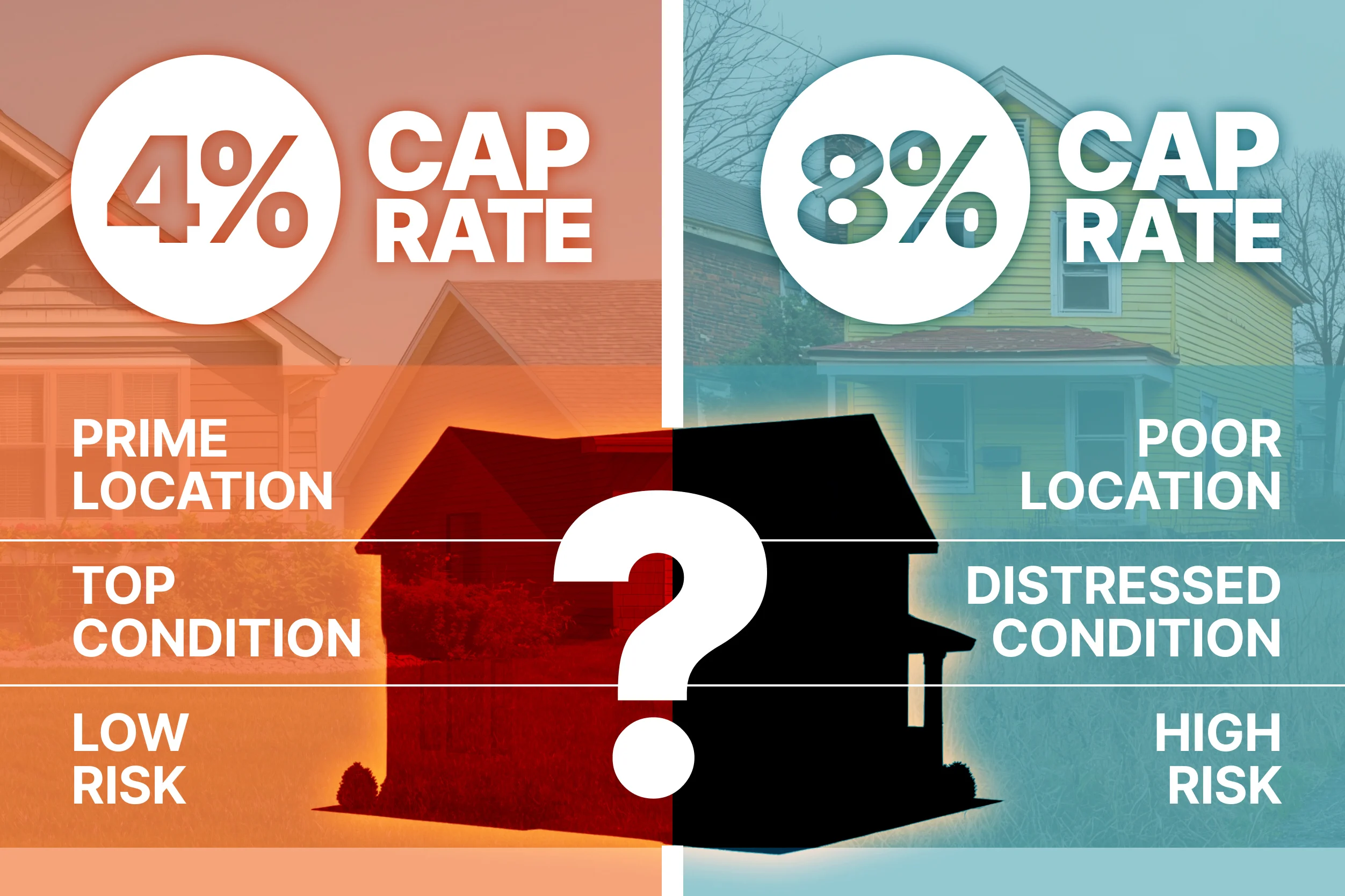
- Lower cap rates (often around 3% to 5%) are typical for prime properties in expensive, in demand locations. Investors accept lower income because they see lower risk and stronger long term growth.
- Higher cap rates (often 7% or more) are common for older properties, smaller towns or areas with weaker demand. The higher income compensates for higher risk.
| Cap rate | What it often signals |
|---|---|
| Below 4% | Premium location, strong demand, low risk, income is secondary |
| 4% to 6% | Solid, well located properties in major markets |
| 6% to 8% | More income focused; secondary markets or older buildings |
| Above 8% | Higher risk, weaker demand, or properties needing work |
General guide only. Ranges vary by country, city and property type.
Compare with interest rates
A useful check is to compare the cap rate with your borrowing cost. If the cap rate is lower than your mortgage rate, borrowing to buy the property creates negative leverage: the loan costs more than the property earns.
In our example, the cap rate is 5.17%. With average 30 year mortgage rates in the US near 7% in September 2026, buying this property with a 75% loan would produce negative cash flow of roughly $3,000 a year before tax. The investor would be relying on rent growth or price growth to make the deal worthwhile.
Compare with safe investments
Many professional investors compare cap rates with government bond yields. In mid 2026, the US 10 year Treasury yield was around 4.6% to 4.7%. When cap rates are only slightly above bond yields, investors are taking on property risk for little extra income.
Cap Rates in 2026
CBRE’s US Cap Rate Survey for the first half of 2026, based on more than 3,600 estimates across over 50 markets, found that average cap rates were essentially flat across all property types, even though the 10 year Treasury yield rose to about 4.67% in May.
Key findings included:
- Cap rates compressed slightly in parts of the eastern US and for some Class B and C and value add properties.
- Around 60% of respondents expected no change over the next six months, but more expected increases than in late 2025, particularly for Class C properties.
- Office properties showed the widest range of estimates, reflecting uncertainty over their value.
- Respondents said the 10 year Treasury would need to fall to around 3.75% to trigger a notable pick up in activity.
For individual investors, the lesson is that property prices have stayed relatively firm even as borrowing costs have risen, which keeps cap rates tight in many markets.
Cap Rate vs Cash on Cash Return: An Example
Let’s return to our $400,000 property with $20,664 of NOI. Suppose the investor puts down 25% ($100,000), pays around $12,000 in closing costs and borrows $300,000 over 30 years at 6.95%.
| Item | Amount per year |
|---|---|
| Net operating income | $20,664 |
| Mortgage payments (principal and interest) | ($23,830) |
| Cash flow before tax | ($3,166) |
| Cash invested | $112,000 |
| Cash on cash return | about minus 2.8% |
The cap rate looks acceptable at 5.17%, but because the mortgage rate is higher than the cap rate, the investor loses money each year on a cash basis. They would need rent increases, falling interest rates or strong price growth to come out ahead. This is why experienced investors always look at both measures.
Cap Rates Around the World
The term “cap rate” is used most in the US and in commercial property. In the UK and Australia, residential investors more often talk about gross and net rental yields, which work in a similar way.
- United States: cap rates on rental properties vary widely, from around 3% to 5% in expensive coastal cities to higher levels in many Midwest and Southern markets.
- United Kingdom: buy to let yields are generally higher in northern cities and Scotland than in London and the South East.
- Canada: yields tend to be lowest in Toronto and Vancouver, where prices are highest relative to rents, and higher in cities such as Calgary and Edmonton.
- Australia: gross yields in the major capitals are often in the 3% to 5% range, with higher yields in some regional areas and smaller cities.
According to the Global Property Guide’s September 2026 data, average gross rental yields were about 5.8% in Canada and 4.9% in Australia, based on major city listings. Remember that net yields and cap rates are lower once expenses are deducted.
Cap Rate vs Other Return Measures
| Measure | What it shows | Includes financing? |
|---|---|---|
| Cap rate | NOI as a percentage of value | No |
| Gross rental yield | Annual rent as a percentage of price | No, and ignores expenses |
| Net rental yield | Rent minus costs as a percentage of price | Usually no |
| Cash on cash return | Annual cash flow after debt payments ÷ cash invested | Yes |
| Total return or IRR | Income plus capital growth over time | Yes, if modelled |
The cap rate is similar to the net rental yield, a term more commonly used in the UK and Australia. Our guide on how to calculate rental yield explains the differences in more detail.
How Investors Use the Cap Rate
1. Comparing properties quickly
Cap rates let you compare a $300,000 duplex with a $900,000 apartment building on the same basis.
2. Estimating value
If similar properties in an area sell at a 6% cap rate and a building produces $60,000 of NOI, a rough value estimate is $60,000 ÷ 0.06 = $1,000,000.
3. Spotting risk
A cap rate much higher than similar properties may signal problems such as deferred maintenance, weak tenants or a declining area. One much lower may suggest the price is too high.
4. Tracking market trends
Rising cap rates across a market usually mean prices are falling relative to income, while falling cap rates suggest prices are rising faster than rents.
Limitations of the Cap Rate
- It ignores financing. Two investors buying the same property can have very different returns depending on their mortgage.
- It is a snapshot. It reflects one year of income and does not capture future rent growth or value changes.
- It depends on accurate numbers. Sellers may present optimistic rents or leave out expenses. Always check the figures.
- It ignores capital expenditure. Major repairs can significantly reduce your actual return.
- It does not measure total return. A low cap rate property in a fast growing area may outperform a high cap rate property over time.
How to Improve a Property’s Cap Rate
Investors who buy value add properties often aim to increase NOI, which raises the cap rate on their purchase price and the value of the property. Common approaches include:
- Raising rents to market levels, where rules and leases allow.
- Reducing vacancy through better marketing and tenant retention.
- Cutting operating costs, for example by improving energy efficiency.
- Adding income, such as parking, storage or laundry.
- Renovating units to justify higher rents.
A Quick Cap Rate Checklist
Before relying on a cap rate, run through these checks:
- Verify the rent. Compare the listed rent with similar properties nearby and ask for a rent roll or leases.
- Include a vacancy allowance, even if the property is fully let today.
- Get real expense figures, such as tax bills, insurance quotes and past maintenance costs.
- Add property management, even if you plan to manage it yourself, so you value your time.
- Check for upcoming capital costs, such as a roof, heating system or building works.
- Compare with similar sales in the same area and property type.
- Compare the cap rate with your mortgage rate to see whether financing helps or hurts.
Common Mistakes to Avoid
- Relying on the seller’s numbers without checking.
- Using asking rent instead of achievable rent.
- Forgetting vacancy, management and maintenance.
- Comparing cap rates across very different markets or property types.
- Ignoring the gap between the cap rate and your mortgage rate.
Frequently Asked Questions
Is a higher cap rate always better?
No. A higher cap rate means more income relative to price, but it often comes with more risk, such as weaker demand or older buildings.
Does the cap rate include my mortgage?
No. The cap rate is calculated before debt payments. Use cash on cash return to see the effect of financing.
What is a good cap rate for a single family rental?
It depends on the market. In many expensive cities, single family rentals trade at low cap rates of around 3% to 5%, while in more affordable areas they may reach 6% to 8% or more.
How do interest rates affect cap rates?
When interest rates rise, investors usually demand higher returns, which can push cap rates up and prices down. However, cap rates do not always move immediately with rates.
Where can I find cap rates for my area?
Commercial property reports from firms such as CBRE, local real estate agents, property managers and listing data can all help. For individual rentals, the most reliable approach is to calculate the cap rate yourself using realistic rents and expenses.
Is cap rate the same as rental yield?
They are closely related. The cap rate is essentially a net yield based on net operating income. Gross rental yield ignores expenses, so it is always higher.
The Bottom Line
The cap rate is a simple, powerful way to compare investment properties: divide the net operating income by the price. In our example, a $400,000 property earning $20,664 of NOI has a cap rate of about 5.2%. A good cap rate depends on location, property type, risk and, crucially, your borrowing costs. With mortgage rates high in 2026, many properties produce negative cash flow when financed, so compare the cap rate with your mortgage rate before you buy.
Use the cap rate as a starting point, then look at cash flow, financing and long term growth. To see which markets investors are favouring this year, read our guide to the best cities to invest in real estate in 2026.