
Last updated: September 2026. This guide explains how to calculate rental yield for properties in the US, UK, Canada, Australia and beyond. It is general information only, not financial or investment advice.
Rental yield is one of the first numbers property investors look at. It tells you how much income a property produces compared with its price, and it makes it easy to compare homes in different streets, cities or even countries.
But there are two very different versions, gross and net, and the gap between them can be large. In this guide we explain how to calculate both, work through examples in four countries, show the costs that differ from place to place and explain what counts as a good rental yield in 2026. We also look at how yield compares with capital growth and how different property types tend to perform.
What Is Rental Yield?
Rental yield is the annual rental income from a property, expressed as a percentage of its value or purchase price. It measures the income return from a property, not including any change in its value.
There are two main types:
- Gross rental yield: based on rent before any costs.
- Net rental yield: based on rent after operating costs.
Investors use gross yield for quick comparisons and net yield for a more realistic picture.
How to Calculate Gross Rental Yield
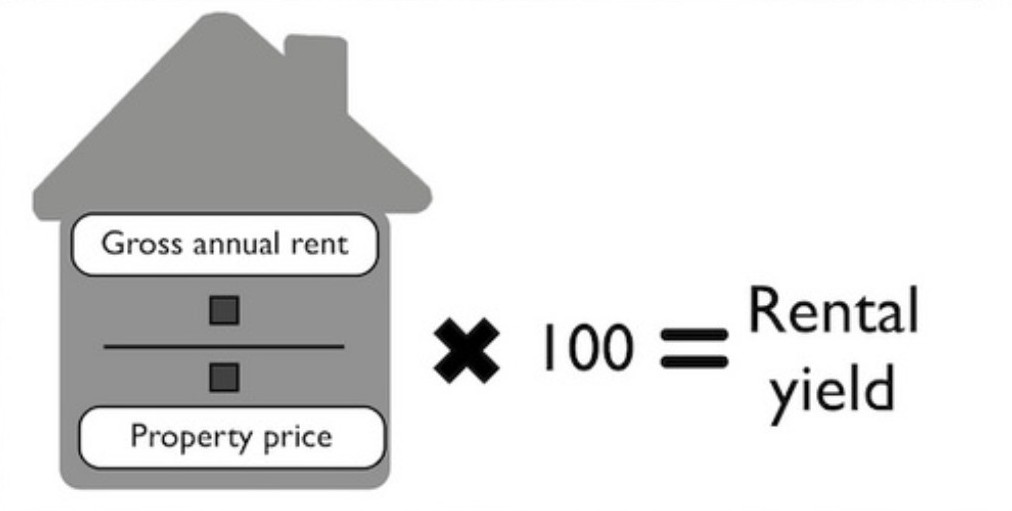
Gross rental yield = (Annual rent ÷ Property price) × 100
Example: a property costs $300,000 and rents for $2,000 a month.
- Annual rent = $2,000 × 12 = $24,000
- Gross yield = $24,000 ÷ $300,000 × 100 = 8.0%
Gross yield is quick and easy, but it ignores all the costs of owning a rental, so it always overstates your real return.
How to Calculate Net Rental Yield
Net rental yield = ((Annual rent minus annual costs) ÷ Property price) × 100
Using the same property, suppose annual costs are $7,000:
- Net income = $24,000 minus $7,000 = $17,000
- Net yield = $17,000 ÷ $300,000 × 100 = 5.67%
Some investors also include purchase costs, such as taxes and legal fees, in the property price. This gives a more conservative figure, sometimes called the yield on total cost.
What costs should you include?
| Cost | Examples |
|---|---|
| Property taxes and rates | Property tax (US, Canada), council rates (Australia) |
| Insurance | Landlord or rental property insurance |
| Management | Letting agent or property manager fees |
| Maintenance and repairs | Routine upkeep, typically budgeted as a percentage of rent or value |
| Building fees | HOA, condo, strata or service charges |
| Vacancy | An allowance for empty periods between tenants |
| Compliance | Safety certificates, licences and inspections |
| Utilities | Any bills the landlord pays |
Net yield usually excludes mortgage payments and income tax. To see your return after financing, use cash flow or cash on cash return.
Why You Need Both Gross and Net Yield
Two properties with the same gross yield can have very different net yields. An apartment with high building fees, or an older house that needs constant repairs, may look attractive on a gross basis but deliver much less once costs are deducted.
As a rough guide, net yield is often 1 to 3 percentage points lower than gross yield, depending on the property and country.
Worked Examples in Four Countries
Rental markets work differently in each country. Here is a simple example from each, using realistic but illustrative figures.
| Country | Price | Rent | Annual rent | Annual costs | Gross yield | Net yield |
|---|---|---|---|---|---|---|
| United States | $300,000 | $2,000 a month | $24,000 | $7,000 | 8.0% | 5.7% |
| United Kingdom | £200,000 | £1,000 a month | £12,000 | £2,800 | 6.0% | 4.6% |
| Canada | C$550,000 condo | C$2,400 a month | C$28,800 | C$9,500 | 5.2% | 3.5% |
| Australia | A$650,000 | A$600 a week | A$31,200 | A$7,800 | 4.8% | 3.6% |
Illustrative examples only. Actual rents, prices and costs vary widely by city and property.
A note on weekly rents in Australia
In Australia, rents are usually quoted per week. To find the annual rent, multiply by 52, not by four times the monthly figure. A$600 a week equals A$31,200 a year.
A note on purchase costs
Transaction taxes can be significant. In Australia, for example, stamp duty on a A$650,000 investment property can run to tens of thousands of dollars. Including around A$30,000 of purchase costs in the example above lowers the net yield from 3.6% to about 3.4%.
Costs That Differ by Country
United States
- Property taxes vary hugely by state and county.
- Insurance costs have risen sharply in some states exposed to hurricanes, wildfires and floods.
- HOA fees apply to many condos and planned communities.
United Kingdom
- Letting agent fees often range from around 10% to 15% of rent for full management.
- Compliance costs include gas safety certificates, electrical checks and, in some areas, landlord licensing.
- Tax: individual landlords can no longer deduct mortgage interest as an expense; instead they receive a basic rate tax credit, which reduces after tax returns for many investors.
- Stamp Duty surcharge: additional properties attract a 5% surcharge on top of standard rates in England and Northern Ireland.
Canada
- Property taxes vary by municipality.
- Condo fees can be substantial and rise over time.
- Rent rules: some provinces limit rent increases for existing tenants, which can affect future yields.
Australia
- Council and water rates.
- Strata levies for apartments and townhouses.
- Land tax in most states once the value of your investment land exceeds a threshold.
- Property management fees, often around 5% to 8% of rent plus letting fees.
What Is a Good Rental Yield?
A “good” yield depends on the market, the property type and your goals. As a general guide:
| Gross rental yield | What it often means |
|---|---|
| Below 4% | Expensive, high demand areas; investors rely more on capital growth |
| 4% to 6% | A balance of income and growth in many major cities |
| 6% to 8% | Strong income; often secondary cities or older properties |
| Above 8% | High income, but often higher risk or weaker growth |
Higher yields are not always better. Areas with very high yields sometimes have weaker demand, higher vacancy or lower long term growth. Many investors aim for a balance of reasonable yield and solid growth prospects.
Yield vs Capital Growth
Property returns come from two sources: rental income (yield) and capital growth (the change in the property’s value). The two often pull in opposite directions.
- High growth areas, such as popular city centres, often have low yields because prices are high compared with rents. Investors accept less income today in the hope of stronger price growth.
- High yield areas, such as smaller towns or less fashionable suburbs, often produce more income but may grow more slowly in value.
Neither approach is always better. A high yield property can provide positive cash flow that helps you hold the investment through difficult periods. A high growth property may build more wealth over time but can cost you money each month if the rent does not cover the mortgage and expenses. Many investors look for a balance, or build a portfolio that mixes both.
Yields by Property Type
Rental yields also vary with the type of property:
| Property type | Typical yield profile |
|---|---|
| Studio and one bedroom apartments | Often higher gross yields, but building fees can reduce net yields |
| Family houses | Often lower yields, but stronger land value growth and longer tenancies |
| Multi unit properties | Can offer higher yields and spread vacancy risk across several tenants |
| Student lets and shared houses | High gross yields, but more management, wear and regulation |
| Short term rentals | Potentially high income, but variable occupancy, higher costs and local restrictions |
Rental Yields Around the World
According to the Global Property Guide (September 2026 data, based on listings in key cities), average gross rental yields included:
| Country | Average gross rental yield |
|---|---|
| Kazakhstan | 10.95% |
| Dominican Republic | 8.53% |
| Indonesia | 8.22% |
| Ireland | 7.66% |
| Italy | 6.61% |
| Canada | 5.80% |
| Mexico | 5.79% |
| Australia | 4.94% |
High headline yields in some countries can come with extra risks, such as currency swings, legal differences, weaker tenant protections for owners or difficulty selling. Foreign buyers may also face extra taxes or restrictions.
Comparing yields across borders
When you compare yields between countries, adjust for more than just rent and price. Consider currency risk, the cost of managing a property from abroad, local taxes for non resident owners, tenant protection laws and how easy it will be to sell. A 7% yield abroad can end up lower than a 5% yield at home once these factors are included.
Rental Yield vs Cap Rate vs Cash Flow
| Measure | What it tells you |
|---|---|
| Gross yield | Rent as a percentage of price, before costs |
| Net yield | Rent after operating costs as a percentage of price |
| Cap rate | Net operating income as a percentage of value; very similar to net yield |
| Cash flow | Money left after all costs and mortgage payments |
| Cash on cash return | Annual cash flow as a percentage of the cash you invested |
Net yield and the cap rate are closely related. Our guide on the cap rate explains how professional investors use it to compare and value properties.
How to Improve Your Rental Yield
- Buy at the right price. Negotiating a lower price increases your yield from day one.
- Set rent at market level. Check comparable properties regularly.
- Reduce vacancy. Keep good tenants happy and market the property well.
- Control costs. Shop around for insurance, maintenance and management.
- Add value. Improvements such as an extra bedroom, better kitchen or furnishings can justify higher rent, although they cost money upfront.
A Step by Step Yield Checklist
- Find the realistic rent by checking similar properties currently let nearby, not just asking prices.
- Convert to annual rent (multiply monthly rent by 12, or weekly rent by 52).
- Calculate gross yield by dividing annual rent by the price.
- List every running cost, including a vacancy allowance and maintenance budget.
- Calculate net yield by subtracting costs from rent and dividing by the price.
- Add purchase costs to the price for a conservative version.
- Compare with similar properties and with your mortgage rate to see whether the numbers stack up.
Common Mistakes to Avoid
- Using gross yield alone to judge a property.
- Forgetting vacancy and maintenance.
- Using the asking rent rather than the rent you can realistically achieve.
- Ignoring purchase costs, especially in countries with high transaction taxes.
- Chasing the highest yield without considering demand, growth and risk.
- Comparing yields across countries without considering taxes, currency and legal differences.
Frequently Asked Questions
What is the difference between gross and net rental yield?
Gross yield uses rent before any costs. Net yield deducts operating costs such as taxes, insurance, management and maintenance, so it gives a more realistic picture.
Should I include my mortgage in the yield?
Usually not. Rental yield measures the property’s income, regardless of how it is financed. To see the effect of your mortgage, calculate cash flow or cash on cash return.
What is a good rental yield in the UK?
It depends on location. Yields are generally higher in northern cities and Scotland than in London. Many investors look for gross yields of around 5% to 7% outside London, but this varies widely.
Why are rental yields low in major cities?
Prices in major cities are high relative to rents, because investors expect stronger long term growth and demand. That pushes yields down.
How do I estimate maintenance costs?
A common rule of thumb is to budget around 1% of the property’s value each year, or 5% to 10% of rent, for routine maintenance. Older properties usually need more.
How often should I recalculate my yield?
At least once a year, and whenever rent, costs or the property’s value change significantly. Rising insurance, rates or building fees can quietly erode your net yield over time.
Can rental yield be negative?
Gross yield cannot, but net yield can be very low or even negative if costs exceed rent, for example when a property is empty for a long time or needs major repairs.
The Bottom Line
Rental yield is a simple way to measure how much income a property produces. Gross yield divides annual rent by the price; net yield first subtracts running costs, giving a more realistic figure. In our examples, gross yields ranged from 4.8% in Australia to 8.0% in the US, while net yields were 1 to 2 points lower.
Always calculate net yield using realistic rents and costs, account for purchase taxes, and weigh yield against growth, demand and risk. If you are investing in another country, get local advice on taxes and regulations before you buy.
Disclaimer: This article is general information only and does not constitute financial, investment or tax advice. Examples are illustrative. Property investing involves risk, including the loss of capital. Rules and taxes vary by country. Seek advice from a licensed professional before investing.