
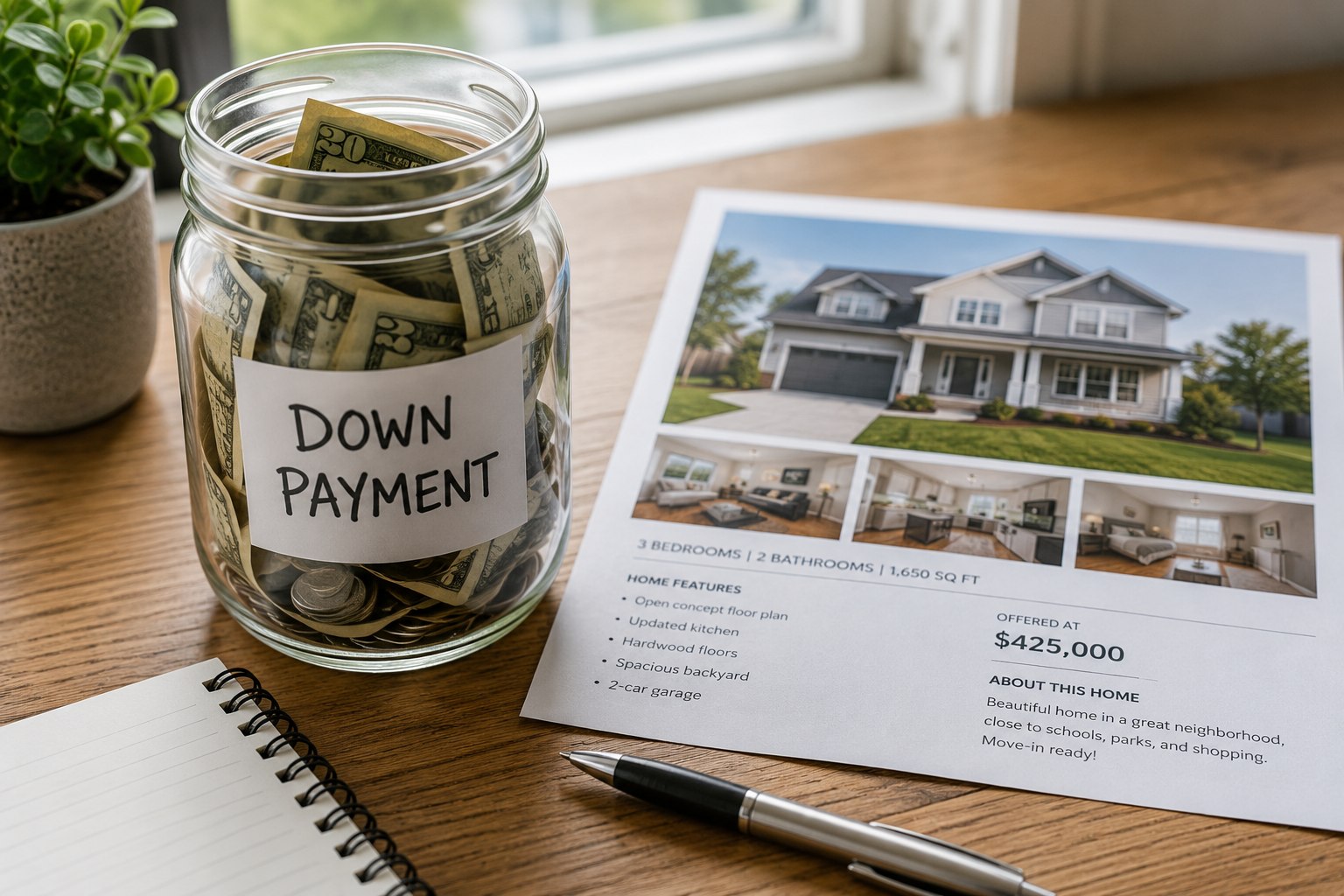
Last updated: September 2026. This guide covers down payment rules for US mortgages. It is educational content, not financial advice.
Many people believe they need to save 20% of a home’s price before they can buy. That myth keeps a lot of renters waiting years longer than necessary. In reality, many buyers put down far less, and some eligible borrowers put down nothing at all.
In this guide you will learn the minimum down payment for each major type of US mortgage, what buyers actually put down, how your down payment changes your monthly cost, and where the money can come from. If you are still working out your budget, our guide on how much house you can afford is a good companion to this one. By the end, you will know roughly how much cash to aim for, which loan could get you into a home soonest and how to avoid the most common down payment mistakes.
The Short Answer
The minimum down payment depends on the loan type:
| Loan type | Minimum down payment | Who it suits |
|---|---|---|
| VA loan | 0% | Eligible service members, veterans and some surviving spouses |
| USDA loan | 0% | Buyers in eligible rural and suburban areas who meet income limits |
| Conventional loan (first time buyer and affordable programs) | 3% | Buyers with good credit, including first time buyers |
| Conventional loan (standard) | 5% | Buyers with good credit |
| FHA loan | 3.5% (10% with a credit score of 500 to 579) | Buyers with lower credit scores or smaller savings |
| Jumbo loan | Often 10% to 20% | Buyers borrowing above the conforming limit |
Lenders can set higher minimums than these program guidelines.
So the real answer is: anywhere from 0% to 20% or more, depending on your loan, your credit and your goals.
What Do Buyers Actually Put Down?
According to the National Association of Realtors (NAR) 2025 Profile of Home Buyers and Sellers:
- First time buyers put down a median of 10%, the highest level since 1989.
- Repeat buyers put down a median of 23%, often using equity from a home they sold.
In other words, most first time buyers do not put down 20%. Rising home prices have pushed down payments up in recent years, but many buyers still use low down payment loans to get started.
Down Payment Requirements by Loan Type
Conventional loans: 3% to 5%
Conventional loans are not backed by the government. They usually follow rules set by Fannie Mae and Freddie Mac.
- 3% down is available through programs such as Fannie Mae HomeReady, Freddie Mac Home Possible and similar options for first time buyers. Some of these programs have income limits.
- 5% down is a common minimum for standard conventional loans.
- If you put down less than 20%, you will usually pay private mortgage insurance (PMI).
In 2026, conventional loans for a one unit home can go up to $832,750 in most areas. Loans above that are jumbo loans.
FHA loans: 3.5%
FHA loans are insured by the Federal Housing Administration and are popular with first time buyers.
- 3.5% down with a credit score of 580 or higher.
- 10% down with a credit score between 500 and 579.
- FHA loans have upfront and annual mortgage insurance premiums, which can last for the life of the loan if you put down less than 10%.
VA loans: 0%
VA loans let eligible service members, veterans and some surviving spouses buy with no down payment and no monthly mortgage insurance. Most borrowers pay a one time funding fee instead, although some are exempt. Putting money down can reduce that fee.
USDA loans: 0%
USDA loans, backed by the US Department of Agriculture, offer no down payment financing for homes in eligible rural and some suburban areas. Borrowers must meet income limits, and the loans carry guarantee fees.
Jumbo loans: often 10% to 20%
Jumbo loans exceed conforming limits, so lenders take on more risk. Many require at least 10% down, and 20% is common, along with strong credit and cash reserves.
How Your Down Payment Changes Your Monthly Payment
A bigger down payment means a smaller loan and a lower monthly payment. Here is an example for a $350,000 home with a 30 year fixed rate of 6.95%, based on this week’s national average:
| Down payment | Amount | Loan amount | Monthly principal and interest |
|---|---|---|---|
| 3% | $10,500 | $339,500 | $2,247 |
| 5% | $17,500 | $332,500 | $2,201 |
| 10% | $35,000 | $315,000 | $2,085 |
| 20% | $70,000 | $280,000 | $1,853 |
Illustration only. Excludes property taxes, homeowners insurance and mortgage insurance.
Going from 3% to 20% down lowers the principal and interest payment by almost $400 a month in this example. On top of that, with 20% down on a conventional loan, you avoid PMI, which could otherwise add roughly $100 to $300 a month on a loan of this size, depending on your credit score and down payment.
Down Payment Amounts at Different Home Prices
Here is how much cash common down payment levels require at different prices:
| Home price | 3% | 3.5% | 5% | 10% | 20% |
|---|---|---|---|---|---|
| $250,000 | $7,500 | $8,750 | $12,500 | $25,000 | $50,000 |
| $350,000 | $10,500 | $12,250 | $17,500 | $35,000 | $70,000 |
| $450,000 | $13,500 | $15,750 | $22,500 | $45,000 | $90,000 |
| $550,000 | $16,500 | $19,250 | $27,500 | $55,000 | $110,000 |
Seeing the numbers side by side shows why so many buyers choose a lower down payment. At higher price points, the gap between 5% and 20% can mean saving an extra $80,000 or more.
Understanding Mortgage Insurance
Mortgage insurance protects the lender, not you, if you stop making payments. It is the main extra cost of a small down payment.
| Loan type | Mortgage insurance with a small down payment | Can it be removed? |
|---|---|---|
| Conventional | Private mortgage insurance (PMI), roughly 0.3% to 1.5% of the loan per year | Yes, usually once you reach 20% equity |
| FHA | Upfront 1.75% plus annual MIP, usually 0.55% | Only after 11 years with 10% or more down; otherwise by refinancing |
| VA | None (one time funding fee instead) | Not applicable |
| USDA | Upfront and annual guarantee fees | No, lasts for the loan |
How PMI goes away
On conventional loans, federal law gives you two ways to end PMI:
- You can ask your lender to cancel it once your loan balance reaches 80% of the home’s original value, if you have a good payment history.
- It must end automatically once your balance is scheduled to reach 78% of the original value.
Some lenders also let you remove PMI earlier if your home’s value has risen, usually with a new appraisal.
Is Putting 20% Down Worth It?
Advantages of 20% down
- No PMI on a conventional loan.
- Lower monthly payment and less total interest.
- Instant equity, which protects you if home prices fall.
- A stronger offer in competitive markets.
- Better rates in some cases.
Disadvantages of waiting for 20%
- Time. Saving 20% on a typical home can take many years, while prices and rents may keep rising.
- Empty savings. Putting every dollar into the down payment can leave you without an emergency fund.
- Missed opportunities. Money used for a larger down payment is not available for repairs, furniture or investing.
For many first time buyers, a smaller down payment with a solid emergency fund is safer than a 20% down payment that leaves no cushion.
Buying sooner vs saving longer
Imagine two buyers looking at the same $350,000 home. The first buys now with 5% down and pays PMI for several years. The second keeps renting while saving for 20% down.
The first buyer pays mortgage insurance and a higher loan balance, but starts building equity immediately and locks in today’s price. The second buyer avoids PMI and borrows less, but continues paying rent and faces the risk that prices or rates move against them while saving.
Neither path is always better. If home prices in your area are rising quickly and you have stable income, buying sooner with a smaller down payment can make sense. If prices are flat, your job is uncertain or you would drain your savings to buy, waiting and saving more may be wiser.
Down Payment Mistakes to Avoid
- Draining your emergency fund to reach a bigger down payment.
- Forgetting closing costs, moving costs and repairs when planning your cash.
- Moving money around right before applying without keeping clear records.
- Taking on new debt, such as a car loan, while saving or during the mortgage process.
- Assuming you do not qualify for help. Many assistance programs have higher income limits than people expect.
Don’t Forget Closing Costs
Your down payment is not the only cash you need. Closing costs typically add about 2% to 5% of the loan amount. On a $340,000 loan, that could be roughly $6,800 to $17,000. They may include:
- Lender origination and underwriting fees.
- Appraisal and inspection fees.
- Title search and title insurance.
- Prepaid property taxes and homeowners insurance.
- Recording fees and local transfer taxes.
Some buyers negotiate for the seller to pay part of these costs, and some assistance programs help with them.
Where Can Your Down Payment Come From?
Lenders need to see that your down payment comes from acceptable sources. Common options include:
- Your savings, including checking, savings and money market accounts.
- Gifts from family. Most loan types allow gift funds, documented with a signed gift letter and bank records.
- Down payment assistance programs. State and local housing finance agencies offer grants, forgivable loans and low interest second mortgages, often for first time buyers.
- Lender grants. Some large banks offer grants or credits in eligible areas. See our guide to the best mortgage lenders for first time buyers.
- Proceeds from selling a home.
- Retirement accounts. You may be able to borrow from a 401(k) or, as a first time buyer, withdraw up to $10,000 from an IRA without the usual early withdrawal penalty (income tax may still apply). Use these carefully, since they reduce your retirement savings.
Large, unexplained deposits in your bank account may raise questions from underwriters, so keep records of where money comes from.
How to Save for a Down Payment Faster
- Set a clear target based on your price range, loan type and closing costs.
- Automate your savings so part of every paycheck goes into a separate account.
- Use a high yield savings account to earn more interest while you save.
- Cut or pause big expenses for a set period.
- Put windfalls to work, such as tax refunds and bonuses.
- Research assistance programs early. Many have income limits, homebuyer education requirements and limited funds.
Frequently Asked Questions
Can I buy a house with no money down?
Yes, if you qualify for a VA or USDA loan, or a down payment assistance program that covers the full amount. You will usually still need money for closing costs, although these can sometimes be covered by the seller or assistance.
Is 3% down a good idea?
It can be, especially if it lets you buy sooner while keeping an emergency fund. Just remember that you will pay PMI and have a higher monthly payment than with a larger down payment.
Does a bigger down payment get me a lower rate?
Often, yes. Lenders see lower risk when you have more equity, which can lead to better pricing, especially on conventional loans.
Can my down payment be a gift?
Yes. Most loan types allow gifts from family members and certain other sources. Your lender will ask for a gift letter confirming the money does not need to be repaid.
Do second homes and investment properties need more down?
Yes. Low down payment programs are generally for primary residences. Conventional loans for a second home usually require at least 10% down, and investment properties often require 15% to 25%, along with stronger credit and cash reserves.
How much should I keep in savings after my down payment?
Many advisers suggest keeping at least three to six months of essential expenses in an emergency fund after closing. Some lenders also require cash reserves.
The Bottom Line
You do not need 20% to buy a house. Depending on your loan, the minimum down payment ranges from 0% for VA and USDA loans to 3% for some conventional loans and 3.5% for FHA loans. First time buyers put down a median of 10% in the latest NAR data.
A larger down payment lowers your monthly payment and can remove mortgage insurance, but it should not come at the cost of your emergency fund. Compare loan options, look into assistance programs and speak with a licensed mortgage professional to find the right balance for your situation.
Disclaimer: This article is for general educational purposes only and does not constitute financial or tax advice. Loan program requirements, limits and mortgage insurance rates change over time and can vary by lender. Always confirm current requirements with your lender and a qualified tax professional.