
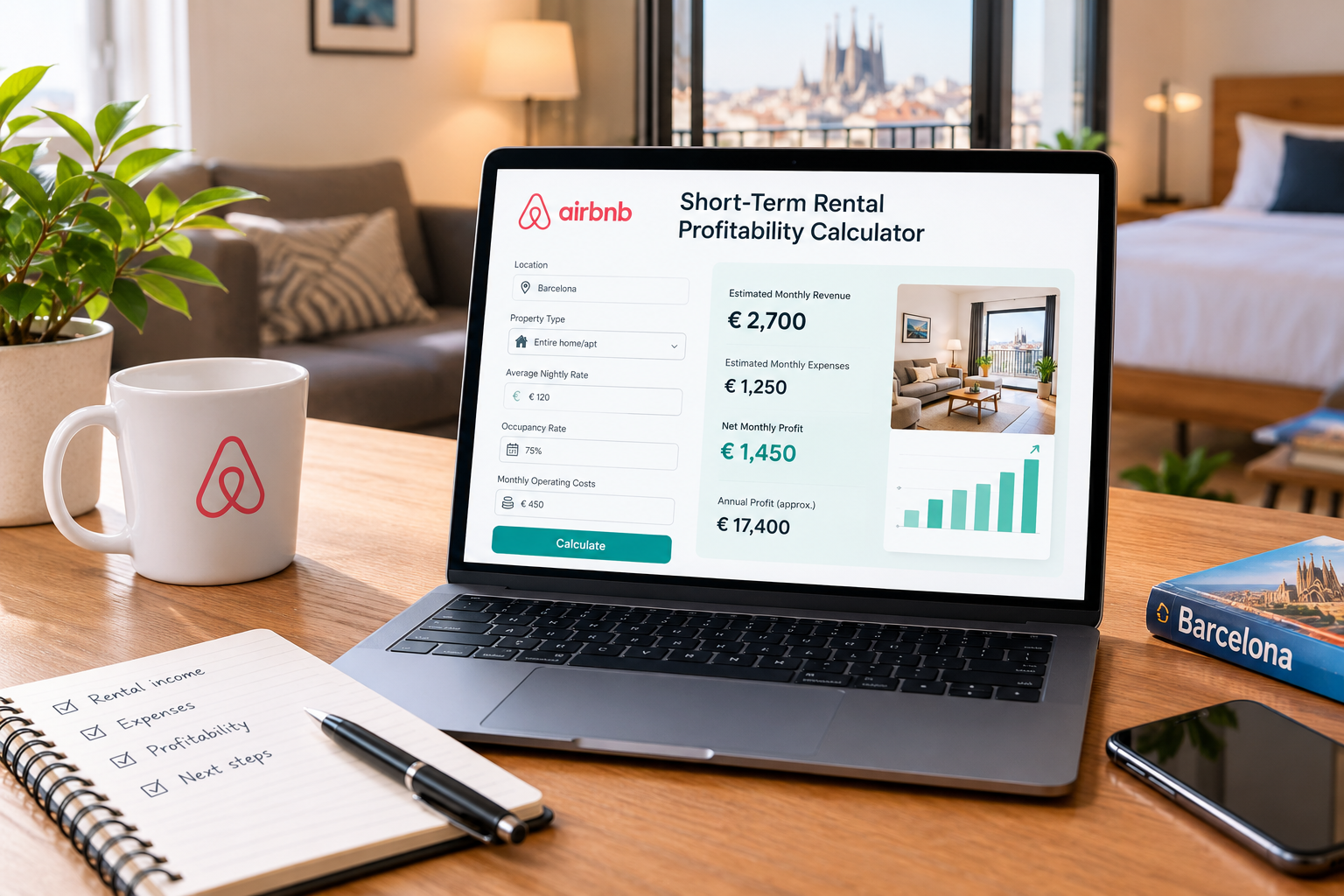
Last updated: September 2026. This guide explains how to estimate the profitability of a short term rental such as an Airbnb or Vrbo listing, with a free calculator and a worked example. It is general information only, not financial or investment advice.
Short term rentals can earn far more per night than a traditional long term let, but they also cost far more to run. Cleaning, furnishing, platform fees, utilities, supplies and empty nights can turn an impressive looking revenue figure into a thin profit or even a loss.
The only reliable way to know whether a property works as an Airbnb is to run the numbers before you buy. In this guide we explain every figure that goes into a short term rental calculation, walk through a complete example, show how sensitive profits are to occupancy and management costs, and give you a free calculator you can use on any property.
The Short Answer
To estimate short term rental profitability:
- Estimate revenue: nightly rate × nights booked, plus cleaning fees charged to guests.
- Subtract operating expenses: platform fees, cleaning, utilities, supplies, insurance, property tax, maintenance and management.
- The result is net operating income (NOI).
- Subtract mortgage payments to find your annual cash flow.
- Divide cash flow by the cash you invested to find your cash on cash return.
A property that produces positive cash flow at a realistic occupancy rate, with a comfortable margin for slow months, is worth a closer look.
The Short Term Rental Market in 2026
According to AirDNA’s midyear outlook, published in July 2026, US short term rentals are on track for:
| Metric | 2026 forecast |
|---|---|
| Average occupancy | 57.4% (pre pandemic average: 57.0%) |
| Demand growth | 2.7% |
| Supply growth (available listings) | 2.7% |
| RevPAR growth (revenue per available rental) | 2.9% |
AirDNA found that slower growth in new listings is helping established hosts maintain occupancy and push nightly rates higher. Mortgage rates above 6% have slowed the flood of new supply seen in 2021 and 2022. Among large markets, San Francisco, Anaheim and Philadelphia showed the strongest revenue growth in the first half of the year, while cross border demand from Canada remained well below 2024 levels.
Market averages hide huge local differences, however. A beach house in a popular resort town and a studio in a city with strict short term rental rules can have completely different results, so always use local data.
Short Term Rental Profitability Calculator
Enter your own figures below. The default values match the worked example later in this guide.
[Insert the calculator HTML block here]
Key Short Term Rental Terms
- ADR (average daily rate): average price per booked night.
- Occupancy rate: share of available nights that are booked.
- RevPAR: revenue per available night, equal to ADR multiplied by occupancy.
- NOI: revenue minus operating expenses, before mortgage payments.
- Cash on cash return: annual cash flow divided by the cash you invested.
Step 1: Estimate Your Revenue
Revenue depends on three numbers:
- Average daily rate (ADR): the average price per booked night, including seasonal and weekend pricing.
- Occupancy rate: the percentage of available nights that are booked.
- Cleaning fees: the amount you charge guests per stay, which offsets your cleaning costs.
Nightly revenue = ADR × 365 × occupancy rate
Example: a nightly rate of $225 at 60% occupancy gives 219 booked nights and nightly revenue of about $49,275. With an average stay of 3.5 nights, that is about 63 stays. At a $120 cleaning fee per stay, cleaning fees add about $7,500, for gross revenue of about $56,800.
Where to find realistic numbers
- Comparable listings: study similar properties nearby on Airbnb and Vrbo, noting prices on different dates and how full their calendars look.
- Data providers: services such as AirDNA and similar tools estimate occupancy, ADR and revenue for individual addresses and markets.
- Local property managers: they can share realistic occupancy and pricing for your area.
Be conservative. New listings usually take time to gather reviews, and many investors plan on lower occupancy in the first year.
Step 2: Add Up Operating Expenses
Short term rentals have more expenses than long term rentals. Here are the main ones:
| Expense | How it is usually estimated |
|---|---|
| Platform fees | About 3% of bookings under Airbnb’s split fee model; around 15% under host only fees, which are standard for hosts using property management software |
| Cleaning | A cost per stay, often partly covered by the cleaning fee |
| Utilities and internet | Monthly, paid by the host rather than the guest |
| Supplies | Toiletries, linens, coffee, cleaning products and replacements |
| Insurance | Short term rental or vacation rental insurance, usually more expensive than standard landlord cover |
| Property tax | Based on local rates |
| Maintenance | A reserve, often around 5% of revenue, because guests cause more wear |
| Management | Often 15% to 30% of revenue for full service management |
| Software and licences | Pricing tools, smart locks, permits and registration fees |
| HOA fees | If the property is in a community or condo building |
Occupancy or lodging taxes are usually charged to guests and passed on to local authorities. On many platforms, some of these taxes are collected automatically, but you may need to register and remit others yourself, so check local rules.
Step 3: Calculate Net Operating Income
NOI = Gross revenue minus operating expenses
NOI excludes mortgage payments and income tax. It shows how much the property earns on its own, which makes it useful for comparing properties. Dividing NOI by the purchase price gives the cap rate.
Step 4: Subtract Your Mortgage
Short term rentals are usually financed with investment property or second home mortgages, which typically need larger down payments and carry higher rates than loans for a main home. Some investors use DSCR loans, which qualify the property based on its rental income rather than your personal income, usually at higher rates again.
Annual cash flow = NOI minus annual mortgage payments
Step 5: Work Out Your Return
Cash on cash return = Annual cash flow ÷ Total cash invested × 100
Total cash invested includes your down payment, closing costs and the cost of furnishing and setting up the property, which is often $15,000 to $40,000 or more for a whole home.
A Complete Worked Example
Imagine buying a three bedroom house for $400,000 in a popular vacation area, with 25% down and a 30 year investment mortgage at 7.25%. The national average 30 year fixed rate was 7.03% in the week of September 24, 2026, according to Freddie Mac, and investment property loans are usually priced higher.
Upfront cash:
| Item | Amount |
|---|---|
| Down payment (25%) | $100,000 |
| Closing costs | $12,000 |
| Furnishing and setup | $25,000 |
| Total cash invested | $137,000 |
Annual figures (self managed):
| Item | Amount per year |
|---|---|
| Nightly revenue ($225 × 219 nights) | $49,275 |
| Cleaning fees charged (63 stays × $120) | $7,509 |
| Gross revenue | $56,784 |
| Platform fees (3%) | ($1,704) |
| Cleaning costs (63 stays × $110) | ($6,883) |
| Utilities and internet | ($4,200) |
| Supplies | ($2,400) |
| Insurance | ($2,800) |
| Property tax | ($4,800) |
| Maintenance reserve (5%) | ($2,839) |
| Software, permits and licences | ($1,080) |
| Operating expenses | ($26,706) |
| Net operating income | $30,078 |
| Mortgage payments ($2,047 a month) | ($24,558) |
| Annual cash flow | $5,520 |
Results:
- Cap rate: $30,078 ÷ $400,000 = about 7.5%
- Cash on cash return: $5,520 ÷ $137,000 = about 4.0%
- Break even occupancy: about 53%
Illustrative example only. Your figures will depend on your market, property and financing.
The property is profitable, but only just. A cash on cash return of 4% is lower than many investors would accept for the work and risk involved, and there is little room for error.
How Sensitive Is Profit to Occupancy?
Occupancy is the biggest driver of short term rental profits. Using the same property:
| Occupancy | Gross revenue | Annual cash flow |
|---|---|---|
| 50% | about $47,300 | about ($2,000) |
| 55% | about $52,100 | about $1,700 |
| 60% | about $56,800 | about $5,500 |
| 65% | about $61,500 | about $9,300 |
| 70% | about $66,200 | about $13,100 |
Each five point change in occupancy moves cash flow by roughly $3,800 a year. That is why a realistic occupancy estimate matters more than almost any other number.
The Cost of Professional Management
If you hire a property manager charging 20% of nightly revenue, management costs about $9,855 a year in our example. Annual cash flow falls from about $5,520 to about ($4,335), a loss of more than $360 a month.
Many short term rentals only work financially if the owner does much of the management, such as handling bookings, messaging guests and coordinating cleaners. Before you buy, decide honestly how much time you can commit, and run the numbers both ways.
Short Term vs Long Term Rental
How does our example compare with renting the same house to a long term tenant for $2,400 a month?
| Short term (self managed) | Long term | |
|---|---|---|
| Gross revenue | $56,784 | $28,800 |
| Operating expenses | $26,706 | about $9,700 |
| Net operating income | $30,078 | about $19,100 |
| Annual cash flow | $5,520 | about ($5,400) |
| Time required | High | Low |
| Furnishing required | Yes | No |
| Regulation risk | Higher | Lower |
Long term expenses assume property tax, landlord insurance, a 5% maintenance reserve and 5% vacancy.
In this example, the short term rental earns more, while the long term rental loses money at today’s mortgage rates. But the short term rental requires much more work, more upfront cash and exposes you to regulation and demand risks. For a deeper look at comparing income across properties, read our guide on how to calculate rental yield.
Regulations to Check Before You Buy
Short term rental rules have tightened in many places. Before you buy, check:
- Local permits and registration. Many cities require hosts to register and display a permit number on their listing.
- Primary residence rules. Some cities only allow short term rentals in a host’s own home.
- Night caps. Some places limit how many nights a year a whole home can be rented.
- Zoning and HOA rules. Homeowners associations and condo buildings may ban short term rentals altogether.
- Occupancy taxes. You may need to collect and remit local lodging taxes.
- Mortgage terms. Some mortgages restrict short term letting, particularly loans for a main home.
New York City’s Local Law 18, for example, sharply reduced short term rental listings when it came into force in 2023. Rules can change quickly, so a property that is legal today may face new restrictions tomorrow.
How to Improve Short Term Rental Profits
- Use dynamic pricing to raise rates at busy times and fill quiet nights.
- Invest in great photos and a strong listing description.
- Add features guests value, such as a hot tub, workspace, games room or pet friendly setup, where they make financial sense.
- Set minimum stays to reduce cleaning and turnover costs.
- Encourage reviews and respond quickly to guests.
- Control costs by comparing cleaners, buying supplies in bulk and monitoring utilities.
- Target longer stays in quiet seasons, such as monthly bookings for remote workers or visiting professionals.
Common Mistakes to Avoid
- Using peak season rates for the whole year.
- Assuming occupancy similar to the best listings in the area.
- Forgetting furnishing and setup costs.
- Ignoring management costs, even if you plan to self manage at first.
- Not checking local rules before buying.
- Underestimating insurance and maintenance.
- Relying on a single market or platform.
Frequently Asked Questions
What is a good occupancy rate for an Airbnb?
It varies by market, but the US average in 2026 is forecast at around 57%, according to AirDNA. Many well run listings in strong markets achieve 60% to 75%, while seasonal markets may be much lower in the off season.
What is a good cash on cash return for a short term rental?
Many investors look for 8% to 12% or more, reflecting the extra work and risk compared with a long term rental. Targets vary with experience, market and financing.
Is Airbnb income taxable?
In most countries, yes. You can usually deduct operating expenses, and tax rules for short term rentals can differ from those for long term rentals. Speak with a tax professional.
Do I need a special mortgage for an Airbnb?
Often, yes. Investment property, second home and DSCR loans are common. Check your loan terms before listing a property you bought with a mortgage for a main home.
How much does it cost to furnish a short term rental?
It depends on size and style, but furnishing a whole home often costs $15,000 to $40,000 or more, including furniture, kitchenware, linens, decor and smart home devices.
Can I use the calculator for properties outside the US?
Yes. Enter figures in your own currency. The mortgage calculation assumes a standard fixed rate loan with monthly payments over 30 years, so results for other loan types will differ.
The Bottom Line
Short term rentals can produce much higher revenue than long term lets, but costs, occupancy and management make or break the numbers. In our example, a $400,000 property earned about $56,800 in gross revenue, but only about $5,500 in annual cash flow when self managed, and lost money once a 20% management fee was included.
Use the calculator with realistic local data, test different occupancy rates, include every cost and check local rules before you buy. If the numbers only work in the best case, the property is probably not the right investment.
Disclaimer: This article and calculator are for general information only and do not constitute financial, investment or tax advice. Examples are illustrative, and market data comes from third party sources such as AirDNA and Freddie Mac. Short term rental regulations vary by location and change frequently. Property investing involves risk, including the loss of capital. Seek advice from a licensed professional before investing.